Five Questions to Ask Before You Book a Foam Party

(And the red- and green-flag answers to look out for)
It can be hard to tell how foam party providers differ or why one company is cheaper than another. But behind the scenes, the differences are significant.
Chicago Foam Company has been around longer than anyone else in the Chicago area, and we’ve produced thousands of foam parties for families, schools, camps, libraries, and large community events. Over the years, we’ve seen what works, what fails, and what actually matters once kids are covered in foam and the party is underway.
We’re also parents. Which means we don’t just think about foam parties as operators—we think about them the same way you do: Who’s coming to my event? What foam are they using? How safe is this? And what happens if something goes wrong?
The questions below are the ones we’d encourage anyone to ask before booking a foam party—whether you’re talking to us or anyone else. The answers will tell you far more than a website or price tag ever could.
1. What kind of foam do you use?
Children at your event will be covered in foam, so what that foam is made of matters—for skin contact and accidental ingestion.
🚩 Red-flag answers:
“We use [brand-name] foam gel.”
“We use foam powder.”
“We use SLS.”
“We use Dawn dish soap.”
“Don’t worry—what we use is very safe.”
Many foam party companies use whatever foam solution comes bundled with their equipment. That foam is usually made from sodium lauryl sulfate (SLS), a strong foaming agent commonly used in detergents. SLS creates big bubbles cheaply, which is why it’s popular—but it wasn’t designed for prolonged skin contact, extended outdoor play, or use by children.
These commercial foam solutions are also often mixed with unnecessary additives, such as glycerin, that don’t meaningfully improve foam performance.
In most cases, this isn’t a deliberate decision. Foam cannon manufacturers make much of their money selling proprietary foam solutions, so many new providers simply stay inside that ecosystem without ever questioning what they’re using. If a company can’t explain why they chose their foam, it’s often because they didn’t choose it at all.
Some providers go further off-script, using imported SLS powders or even dish soap. (If a foam party smells like dish soap, that’s usually because it is dish soap.)
🟢 Green-flag answer:
Sodium Laureth Sulfate (SLES)
A more thoughtful approach is sodium laureth sulfate (SLES), a modified version of SLS that’s significantly less irritating and commonly found in soaps, shampoos, baby shampoos, and toothpaste. SLES is designed for regular skin contact and is far better suited for the kind of play foam parties involve.
Companies that use SLES typically also understand dilution, water quality, and foam concentration—because choosing a different ingredient requires intentional design, not default settings.
For example, Chicago Foam Company produces its own foam using SLES, diluted to over 99% water, specifically for comfort, easy cleanup, and extended outdoor play. We source exclusively from California to take advantage of the strictest environmental regulations in the country.
2. What kind of insurance do you carry?
More than just protection in the event of an incident (which would be extremely rare), proper insurance is a sign you’re working with a serious professional company.
🚩 Red-flag answers:
“Yes, we’re insured.” (with no details)
“We have a certificate of insurance.”
“We’ve never had an issue.”
Uncertainty about adding additional insureds
Insurance coverage in the foam party world varies widely. Some companies operate without insurance at all. Others carry inexpensive, single-person policies designed for solo performers (like clowns and jugglers)—not companies running equipment-heavy events for large groups of children.
There are also low-cost online insurance options that will issue a certificate of insurance, but include so many exclusions and operational requirements that a real foam party would fall outside the policy’s coverage. In those cases, a company can technically say they’re insured—even though the specific event you’re booking wouldn’t actually be covered if something went wrong.
Clients usually have no way of knowing this. A certificate looks official, and policy details are rarely shared unless someone knows exactly what to ask.
🟢 Green-flag answers:
Full business liability insurance
Clear explanation of coverage and limits
Ability to add venues or organizations as additional insureds when required
A company that understands its insurance and can explain how it applies to real events is signaling that it expects to operate responsibly—not just check a box. Sufficient foam party insurance also means being able to add additional insureds to a policy for no cost. (Even if you don’t need to be an additional insured for your event, a company that’s not able to do additional insureds isn’t doing events for–and is thus not trusted by–organizations like schools, park districts, etc.)
Chicago Foam Company carries full business general liability insurance through a major, A+ rated insurer, and can add unlimited additional insureds for no cost to you.
3. How many foam cannons do you own?
A one- or two-cannon company has no margin for error when something doesn’t go perfectly.
🚩 Red-flag answers:
“We have one really good cannon.”
“We use the same setup for every event.”
Vague answers about quantity or type
Companies that own only one—or even two—foam cannons are operating on a knife’s edge. If that equipment has a mechanical issue, gets damaged in transit, or simply doesn’t perform as expected, there’s no backup. When that happens, cancellations often ripple across an entire weekend of events, leaving customers scrambling at the last minute.
This isn’t hypothetical. Every summer, we hear from families and organizations who reach out in a panic:
“We booked another foam party company, but they canceled at the last minute. Can you save our event?”
In almost every case, the root cause is limited equipment or personnel and no redundancy. When a company’s entire operation depends on one piece of gear and one single human operating it, there’s no margin for error.
Foam cannons also aren’t one-size-fits-all. A toddler birthday, a school field day, and a large community festival all require different foam output, throw distance, and control.
🟢 Green-flag answers:
Multiple foam cannons
Different models for different types of events
Built-in backup equipment
Companies with a range of equipment aren’t just more flexible—they’re more reliable, because a single issue doesn’t put your event at risk.
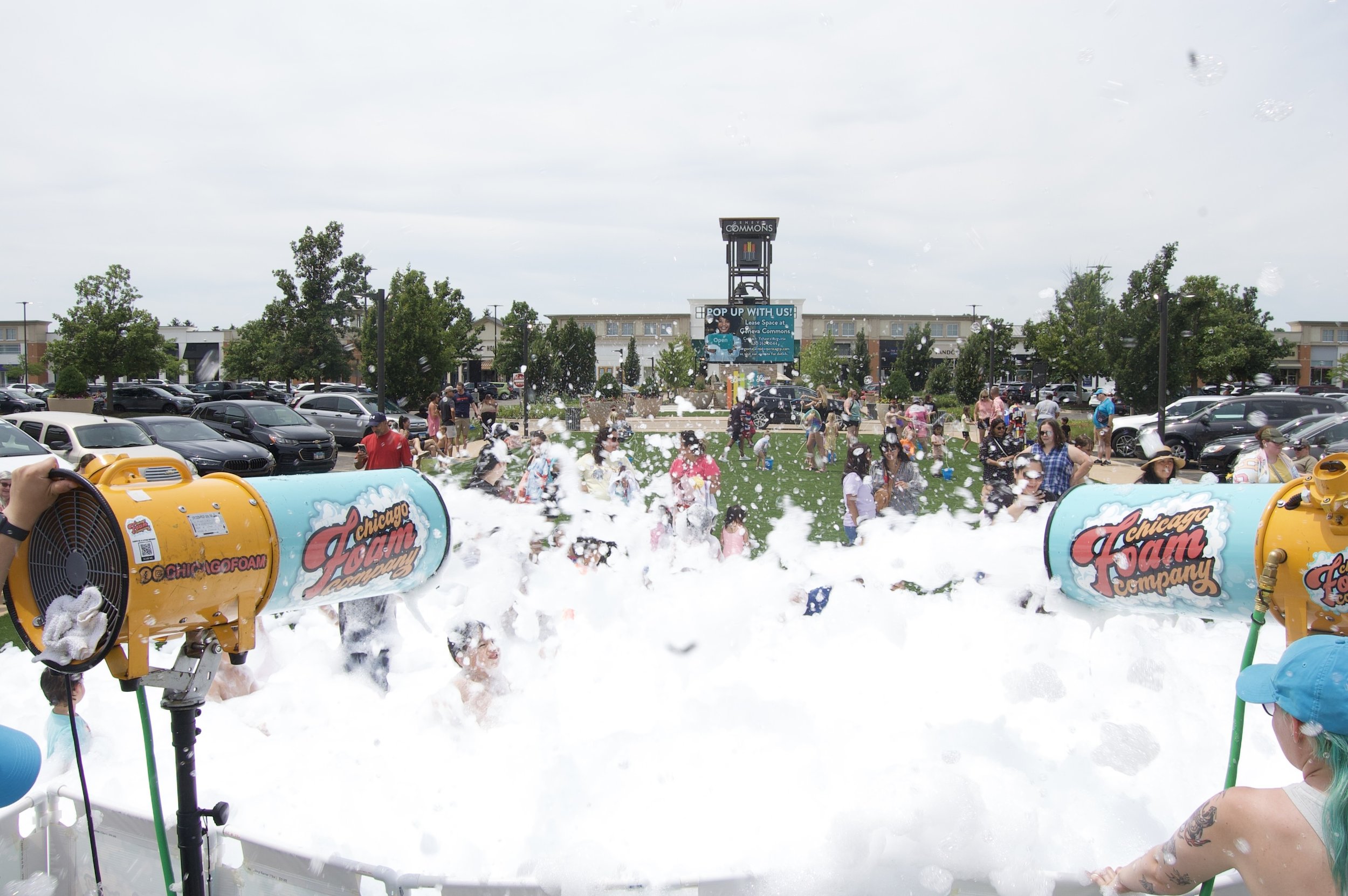
Chicago Foam Company owns multiple foam cannons across several models and manufacturers, allowing us to choose the right tool for each event—and to step in when others can’t.
4. Do you background-check the people who will be running my event?
Foam parties are live events with excited kids and moving parts. It matters who’s showing up to run them.
🚩 Red-flag answers:
“I personally do every event myself.”
“They’re people we trust.”
“It’s usually family or friends.”
Inability to name a background-check provider
This question often reveals how a company is structured. A vague or inconsistent answer may indicate informal hiring practices—or a one-person operation where a flat tire or illness can cancel your event outright.
Companies that regularly work with kids tend to have repeatable hiring systems, not ad-hoc staffing.
As a note–it’s easy for an unscrupulous foam provider to lie and say “yes” in response to this question, so follow up with “What company do you use for background checks?” Anything besides a direct answer naming the company is a major red flag.
🟢 Green-flag answers:
Consistent background checks
Named screening provider
Formal hiring and training process
Chicago Foam Company hires teachers, camp counselors, and college students with experience supervising kids, runs background checks as part of our hiring process, and retains operators season after season.
5. What happens if something goes wrong on event day?
Foam parties depend on equipment and people—both of which operate in the real world, where occasional issues are inevitable.
🚩 Red-flag answers:
“That’s never happened.”
“We’ve never had an issue before.”
“We’d figure it out.”
“We do our best.”
These answers usually mean there is no actual plan—just hope. Foam cannons are mechanical devices that run hard all summer. Fans fail. Pumps fail. Operators get sick. Vehicles get flat tires. When a company is built around a single cannon and a single person, even a minor issue can force a cancellation.
In those cases, the problem isn’t just one event—it’s every event that company has scheduled that day or weekend. With no redundancy, there’s no way to recover.
🟢 Green-flag answers:
Backup foam cannons ready to deploy
An additional trained operator on call
The ability to swap equipment or staff without canceling events
Companies that can answer this question clearly are telling you they’ve seen real-world problems before—and designed their operation so those problems don’t affect clients.
For example, Chicago Foam Company runs more than 500 foam parties each summer. In a typical season, a small number of those events—five or ten—will involve a significant equipment or staffing issue somewhere behind the scenes. The important part is this: none of those clients ever experience a “problem.”
Our systems kick in. Backup equipment is deployed. An extra operator heads to the event. The foam party runs smoothly.
That’s what redundancy is for. Not because problems are common—but because when they do occur, the solution needs to already be in place.
Final Thoughts
Foam parties may look interchangeable online, but the experience behind them can be very different. Asking a few thoughtful questions can quickly reveal whether a company has made intentional choices—or is simply running the default setup that came with their equipment.
If these questions helped clarify what matters for your event, we’re happy to help you plan a foam party that’s safe, well-run, and genuinely easy on your end.
Share a few details below and we’ll follow up.